Friday, January 29, 2016

Project Owlnet- Boyce Mayview Station

This year marked the second year of operating the Project Owlnet station in Boyce-Mayview Park, located in Upper St. Clair. Despite an early large movement of owls to our north, it was a slow season for banding the species through the Appalachian area. However, this year we banded four Northern Saw-whet owls in the park, all of them females. We had numerous visitors to the park to see the process. Some of these visitors were lucky enough to see an owl, and some were not. Attempting to catch and band Northern Saw-whet Owls requires a lot of patience! 

As you may know, these small owls (our smallest owl species in this area) migrate from the boreal forest in Canada to areas south for the winter. There are some breeding populations in the higher elevations of West Virginia and Central Pennsylvania, however, most birds are coming from the boreal forest and continuing south to find food in the fall. The peak of the migration for our area seems to be right around Halloween through mid-November. Last year, our first owl was caught on the night of 29 October; this year our first owls showed up in our nets on 2 November, when it was a two-owl night. 

We capture and band these birds in order to better understand their migration and factors which may affect their migration. As with any other bird which is netted, biometric information such as mass, wing length, age and sex is gathered without harm to the bird. Birds are banded and released to continue on their way. The data we collect is pooled with other stations' information in order to further study this secretive migrant of the night. 
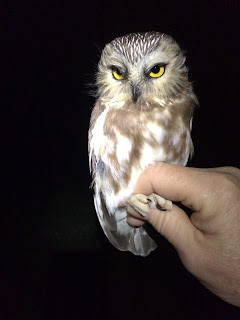


An adult female Northern Saw-whet Owl prior to release from the station.


These owls are small, but very efficient hunters; notice the talons. 


By examining the feathers, we are able, in most cases, to determine the age of the bird.


Ultraviolet light is used to examine the wing of the Northern Saw-whet Owl. Owls have a chemical in their feathers called porphyrin. Ultraviolet light reveals the amount of porphyrin in the wing; the brighter purple or pink feathers have more porphyrin than do other feathers. This tells us that the feathers are fresher than the ones with less saturation of color. Based on what we know about how this species molts its feathers, this helps us determine, rather precisely, the age of the bird.

We will be offering several public nights in the park next fall, so watch for announcements either here or through the Outdoor Classroom if you are interested in learning more about this captivating species.

MAPS in MINGO...what?

This summer brought a new project my way. I established a MAPS (Monitoring Avian Productivity and Survivorship) station in Mingo Creek Park, with support from Powdermill Avian Research Center, the environmental research station of the Carnegie Museum located in the Laurel Highlands and the Washington County Department of Parks. 

MAPS is a program staffed by researchers and citizen scientists which monitors the breeding populations of local species in many areas across the world. The data collected by MAPS stations is often used by other researchers to investigate what may be affecting breeding populations of birds. 

This year, with the help of several people, the Mingo MAPS Station was operated for the full breeding season in our area. This involved eight visits from the end of May to the beginning of August to our established area in the park. Before dawn, mist nets were erected and opened. Banding ran for six hours for each visit. 

We were surprised on our first visit to capture and band several Brown Thrashers. Several were in breeding condition so this tells us that there is a breeding population of this species in the park. We hoped to capture some of the young later in the season, but we did not. We do not know if the species successfully bred. Birds face many challenges to their survival, especially when in the nest when they are very vulnerable to predators. 

We were happy to find a breeding population of Blue-winged Warblers in the park. These warblers are often found in early successional habitat and woodlands.They spend winters in Central America.

We also found numerous breeding pairs of Yellow Warblers. These birds seemed to be ubiquitous in the park, continually singing and appearing in our nets and nearby branches, seemingly watching us. 
Another surprise was to find two Bobolinks in the park. We hoped to find one in our nets, but they managed to stay clear of the nets! 

This project will return to Mingo this coming late spring through summer. Feel free to stop by if you see us and learn a bit about these birds. There will be a public program offered in early June. Look for the program schedule from the Washington County Parks. 


Brown Thrasher


Blue-winged Warblers


Common Yellowthroat 


The stunning wing of a Northern Flicker 


The stately Blue Jay 


Red-winged Blackbird 


Hatch-year Wood Thrush 

Winter is Catch-Up Time

Sometimes it takes awhile to update the blog, but winter is a good time to do it. It was a very successful breeding season in the park this summer with several active nests. Thirteen Eastern Bluebirds and thirteen Tree Swallows hatched and fledged from the nestboxes this summer. Some of the banded young Eastern Bluebirds have been seen in the park this winter. Hopefully, some of them will nest here this spring. 
Here are some photo highlights from the spring and summer: 


Eastern Bluebird eggs in a nestbox.  After about 14 days of incubation, the eggs hatch and after about eight days the hatchlings look like this...


then  this...

 and this ...

 still growing...


The screen on this box helps prevent predators from reaching the birds or the eggs. The cylindrical-shaped metal, known as a "baffle" which you may notice on the poles also prevents predators such as snakes or raccoons from climbing the poles and reaching the birds. Two of the baffles have disappeared this winter. If you have information on how they disappeared, please email me. There is a cost involved to replace them. Please do not remove them. 

This is a female adult Tree Swallow, which nested here last year as well. We know that it is the same bird because last year I banded her with a lightweight aluminum band with a unique 9-digit number on it. After I caught her this year, I was able to look up her band number and see that she also nested here last year. She had another successful breeding season and hopefully will return this spring.

Thursday, May 21, 2015

Boyce-Mayview Update

Rehabilitation of nest boxes in Boyce-Mayview Park continues. Some of the boxes will likely be removed as the surrounding habitat is not conducive to Eastern Bluebird nesting. It may be that these boxes were placed years ago and the vegetation has grown up around them. We are working to put baffles around the poles upon which the boxes are mounted. Baffles keep predators such as snakes, raccoons and other mammals out of the boxes. Baffles also help to eliminate the problem of mice taking over the nesting sites. Two of the first three boxes to which we attached baffles had nesting mice in them. We evicted the mice and after installing the baffles, no mice have been found in the boxes.

An Eastern Bluebird pair began nesting in one of the boxes in the Gardens area, and four eggs hatched. Sadly, after some particularly unseasonable cold and wet weather, the hatchlings were found dead in their nest. There were blowfly larvae found in the nest. Some research suggests that blowfly larvae do not significantly increase hatchling mortality. However, the same research suggests that the combination of blowfly larvae and cold, rainy weather may play a factor.

Hopefully, there will be other successful nestings in the park this year. Stay tuned. 

Tree Swallow Happenings


There are currently two Tree Swallow nests with eggs soon to hatch. These impressive acrobatic flyers may buzz you as you pass near their nesting sites.  So far, they have never hit me, even as I check their nests and watch them fly straight toward me. They often will call in reinforcements and I am then surrounded by fast, furious flyers with snapping bills and chattering alarm calls.

Their softer side is revealed in the exquisite nests which they construct, using feathers plucked from wherever they happen to find them. Take a peek inside.

Tree Swallows use dried grasses to construct a nest, sometimes a very shallow nest, which they then line with soft feathers. Some people will throw feathers from a pillow into the air near nest-building Tree Swallows and watch as the birds pluck the feathers out of the air. It is rumored to be quite the spectacle. The feathers in this box have come from the Tree Swallow's environment; I prefer to see what they find rather than provide them with feathers.

Two Tree Swallows which I banded last year have returned to nest in the park. One chose the very same box in which she nested last year. The other one arrived after the bluebirds had already claimed the box she had used last year. This year the bluebirds got an earlier start on nesting than did the Tree Swallows.


Blues on the Way

These bluebird nestlings will soon fledge from their nest. The parents have been vigilant in caring for them, and they dive-bomb each time I check the nest. I am always glad when they do that as I approach the nest; it lets me know that they still have something to guard and care for.

Sadly, this was not the case with one of the other nestboxes. I found it odd that the male and female did not seem to spend a lot of time around the box. Despite this, five eggs did hatch in that box. However, one day, after some very hot and humid weather, I found all five nestlings dead. There were no signs of predation or insect infestation. It is possible only to guess at what happened. Did something happen to the mother? Did the excessive heat play a role in their demise? Were the parents too inexperienced to raise this brood? I can only record my observations and guess at what may have occurred. What do you think?

Tuesday, April 28, 2015

Tree Swallows

I never seem to have the correct camera with me when these moments happen. A pair of Tree Swallows have been busy with nestbuilding in this box and I happened to see them perched atop the box the other day. I expect that soon, there will be eggs.

Here is a look inside the Tree Swallow nest box.. Tree Swallows also use grasses to craft their nest, and then they go in search of feathers to line the nest. There are more feathers inside the cup of this nest and I suspect they will add more before eggs are laid. Tree Swallows defend their nests more aggressively than the Eastern Bluebirds, so if you happen to be walking too close to the box, do not surprised if you are dive-bombed by a Tree Swallow. You may hear them chattering and snapping their bills, but they will not harm you. Best to keep your distance so they can successfully fledge young.